

In early 2025, the Gamble House faced an unprecedented crisis as the Eaton Fire spread rapidly nearby, putting the historic home and its irreplaceable collection at risk. With limited staff and time, the team acted swiftly to safeguard key objects, using careful planning along with CatalogIt to protect and track the collection under pressure.
The Gamble House is a historic American Craftsman home in Pasadena, California, designed by the architectural firm Greene and Greene and completed in 1909. Built as a winter residence for David B. Gamble, son of Procter & Gamble co-founder James Gamble, it is a National Historic Landmark and an internationally recognized masterpiece of the American Arts and Crafts movement.
The Gamble House collection, overseen by Jennifer Trotoux, Director of Collections and Interpretation, centers on the original furnishings designed specifically for the house, complemented by decorative arts from the Gamble family and later donations. These include Asian metalwork and ceramics, Persian rugs, and a notable collection of American art pottery, particularly Rookwood.
.jpeg)
The Gamble House and its collection, long preserved with care, were suddenly at risk when the Eaton Fire ignited in the San Gabriel Mountains on the evening of January 7, 2025. Fueled by powerful Santa Ana winds, it quickly spread into nearby communities, including Pasadena. By the following morning, the Gamble House was under an evacuation warning, forcing staff to make rapid and difficult decisions about which objects could realistically be moved to safety.
“We could not remove something like the Gamble’s dining table, for example, which is probably the most striking and perhaps even the most significant piece of furniture in our collection," shared Jennifer. “It was out of the question to take it out of the house. So, we had to look at a combination of what was feasible [to take] in terms of transportation, storage, and what we could get out in a short amount of time,” said Jennifer. “These decisions were also informed by the work we had done to identify priorities and categories within the collection as we developed a Collections Management Policy.”
The broader context of the fire further constrained their options. This was not a localized emergency: driven by high winds, the Eaton Fire spread rapidly while other fires burned across the greater Los Angeles area. Staff availability was limited, as many employees themselves were under evacuation warnings or protecting their own homes, and fire crews were deployed throughout the region. In this highly unusual situation, the team relied on just three staff vehicles to transport 33 carefully selected objects offsite.
.png)
Once the objects had been moved to safety, Jennifer’s immediate priority was maintaining clear oversight of what had been removed. From home, she created a dedicated folder in CatalogIt and added all 33 objects that had been evacuated, creating a single, shareable record the team could rely on. This made it easier to track the objects offsite and communicate clearly with colleagues during an otherwise chaotic period.
“Being able to see exactly what’s moving where so easily—without relying on my computer and also having it available on a mobile device, especially offsite—was really helpful!” Jennifer explained. With limited time onsite and the need to leave quickly, having access to the collection records from anywhere provided reassurance that nothing would be lost or overlooked.
When staff were able to return the following week, the same CatalogIt folder served as a checklist to confirm that all objects had been safely returned to the house and placed back in their proper locations. That clarity also extended beyond the immediate response. In a subsequent board meeting held over Zoom, Jennifer was able to share her screen and show board members the objects selected for evacuation. “Everyone was fascinated to see them all in one place, and to pair my explanation of our process with the sight of the objects that were affected,” she shared.
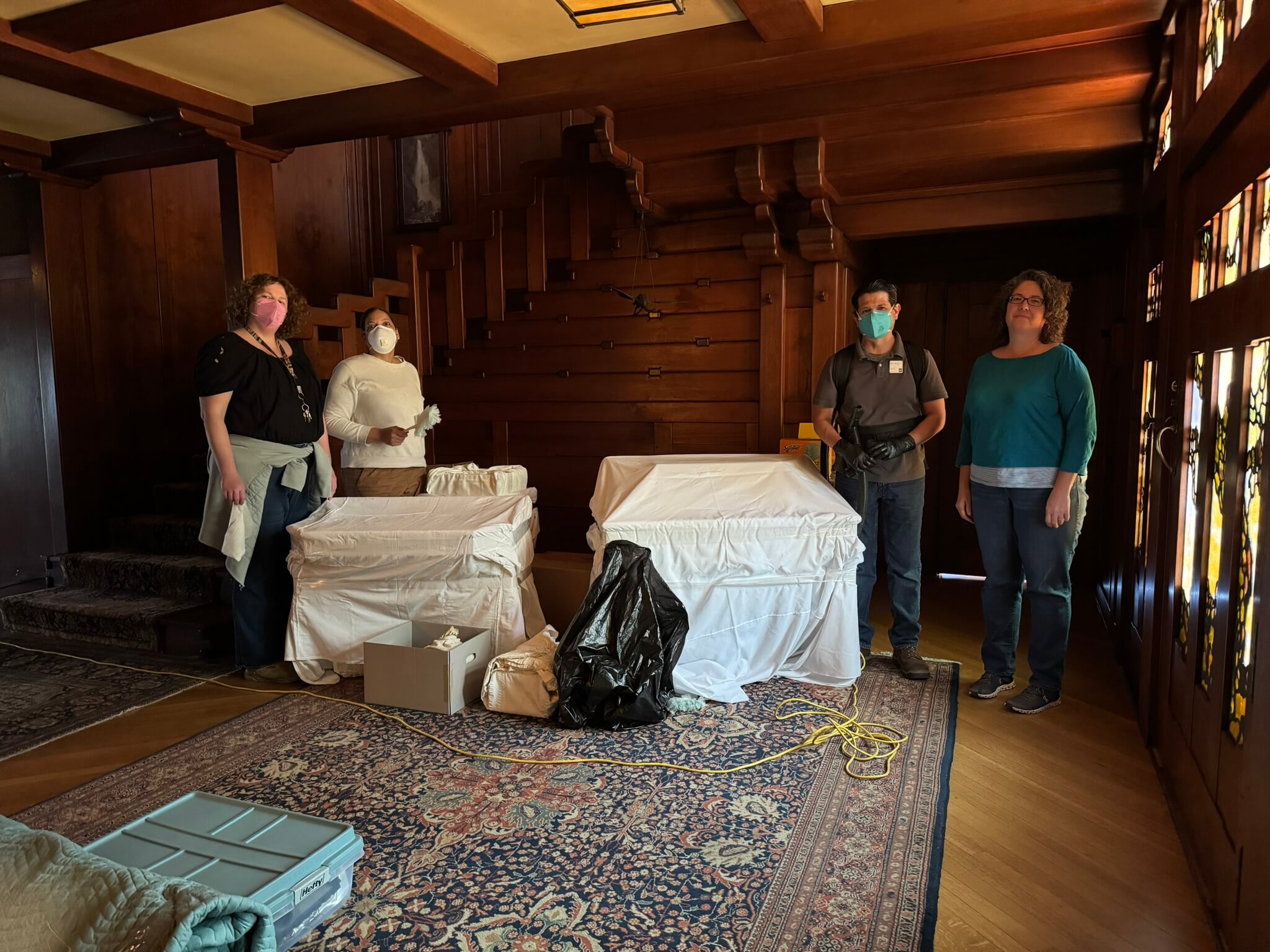
With the house and collection unharmed, staff turned their attention to supporting the Pasadena community and fostering recovery. The evacuated objects remained offsite for one week, and the house was closed to the public for two weeks. When it was safe to reopen, a community open house was held to intentionally offer respite during a period of uncertainty. The goal was to give visitors a place to sit, breathe, and connect with others who had experienced similar disruption, especially those unable to return home due to evacuation orders or smoke damage.
“So many more lives were disrupted than just those who lost their houses: thousands and thousands of people in all,” Jennifer explained. Burning for 24 days, the Eaton Fire claimed at least 19 lives and destroyed over 9,000 buildings, making it the fifth deadliest and second most destructive wildfire in California history. “We wanted to provide a community space where people could gather and simply have somewhere to relax,” she said. The response was immediate and affirming: more than 450 people attended the open house. “We felt like we were really doing the right thing in response.”
In the months that followed, the Gamble House continued to find ways to bring people together and support recovery. “We’ve been finding ways to respond not just to the broader community, but also to our docent community, which is about 200 people,” Jennifer noted. Building on that commitment, staff launched a free “Respite Recital” series on the terrace and hosted a summer camp for children affected by the fires. While the fire’s impact was significant, with at least a dozen docents having lost their homes or being unable to return for months, the focus remained on care, connection, and long-term support.
.jpg)
The Eaton Fire was the first crisis of this scale in the Gamble House’s more than a century-long history, highlighting the unique vulnerabilities of a house museum. “We’ve been looking at ways to strengthen the fire protection of the house itself, because a house museum is in a unique position,” explained Jennifer. “The museum isn’t just a container that protects the objects—we also think of it as the most important object in our collection.”
The experience underscored the importance of layered, site-specific preparedness. Key measures now include proactively managing vegetation, evaluating which nearby trees pose risks or offer protection based on flying ember direction, and implementing procedures such as wetting down the grounds before evacuation. Additional planning for the collection itself proved equally critical. “We’ve also been thinking about how using CatalogIt folders will help us make decisions more quickly and responsively,” Jennifer noted, highlighting how the platform could be effectively utilized in future emergencies.
The Gamble House’s experience during the Eaton Fire emphasizes the value of preparation, prioritization, and thoughtful use of technology in responding to a crisis. By integrating CatalogIt into their emergency procedures, staff were able to safeguard the most important objects, make rapid decisions under pressure, and maintain clear oversight of the collection. At the same time, the museum provided leadership and support to its staff and the broader community during an unprecedented event.
“We certainly hope we never face a disaster like this again,” Jennifer reflected. “But having gone through it, we feel that if something more localized were to happen, we would have a better handle on what to do, because we’ve already faced something very challenging.” Looking ahead, she added, “Our hope is to build some kind of institutional memory around how to handle a situation like this and pass along what we learned—not only to our future selves, but to future staff who will succeed us.”


